Gefilte fish
A poached fish dish central to Ashkenazi Jewish cuisine and tradition.
Gefilte fish is a dish made from a poached mixture of ground deboned fish, such as carp, whitefish, or pike. It is traditionally served as an appetizer by Ashkenazi Jewish households, popular on Shabbat and Jewish holidays such as Passover, and may be consumed throughout the year. Historically, gefilte fish was a stuffed whole fish consisting of minced-fish forcemeat stuffed inside the intact fish skin, but by the 16th century cooks had started omitting the labor-intensive stuffing step, and the seasoned fish was most commonly formed into patties similar to quenelles or fish balls.
- origin
- Likely originated in non-Jewish, German cooking; earliest reference circa 1350 CE in a Middle High German cookbook
- main_ingredients
- Ground deboned fish (carp, pike, mullet, whitefish, or salmon), eggs, breadcrumbs or matza crumbs, onions, carrots, spices
- traditional_serving
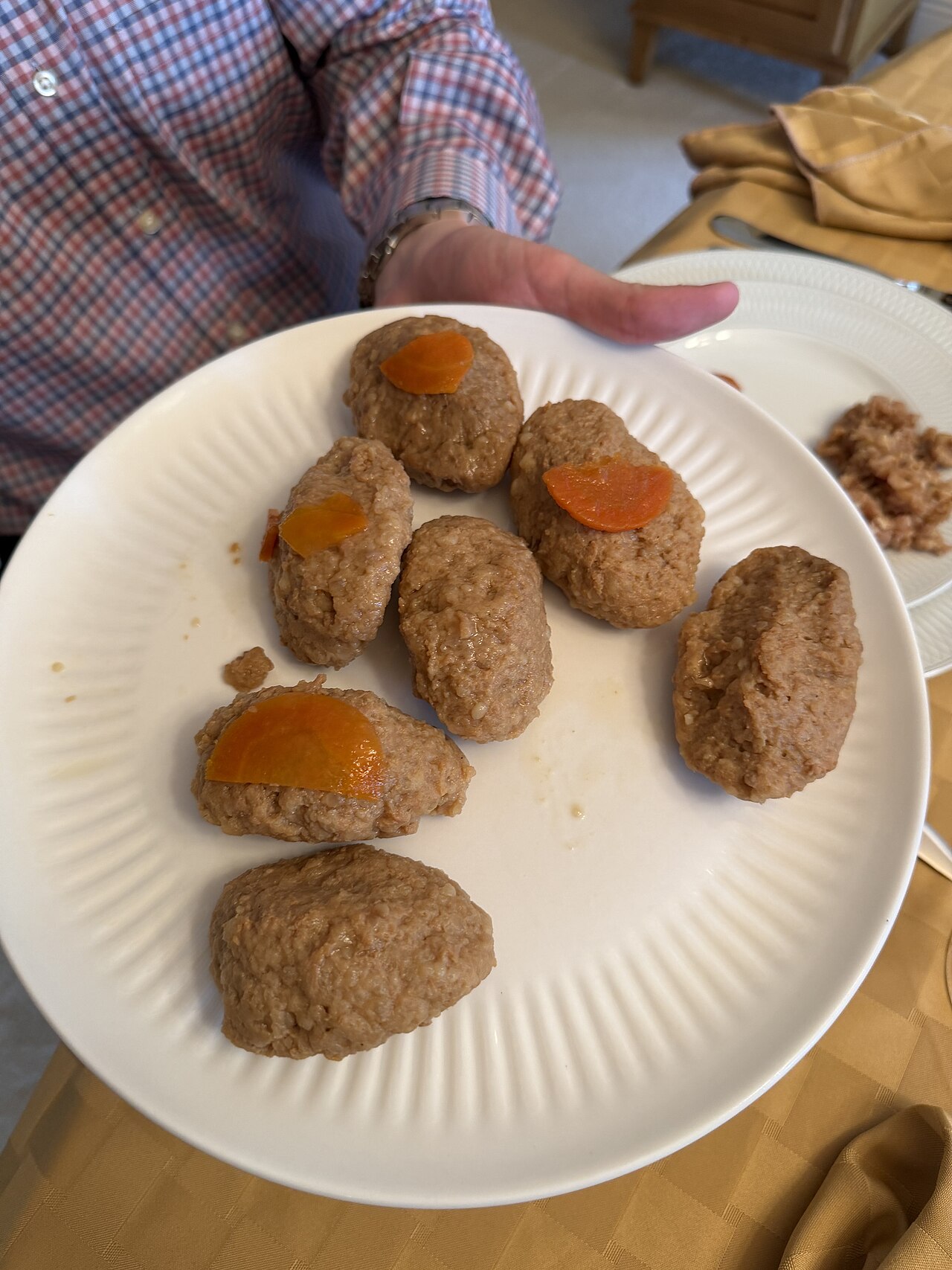
- As an appetizer, garnished with a slice of cooked carrot and horseradish mixture (chrain)
- sweet_vs_savory
- Sweet version popular among Galician Jews; savory (with black pepper) preferred by Litvak Jews
- religious_significance
- Avoids borer (prohibited selection of bones on Shabbat); considered an aphrodisiac and good luck charm
- commercial_form
- Sold in cans and glass jars, packed in jelly from fish broth; also frozen logs
Lore & Background
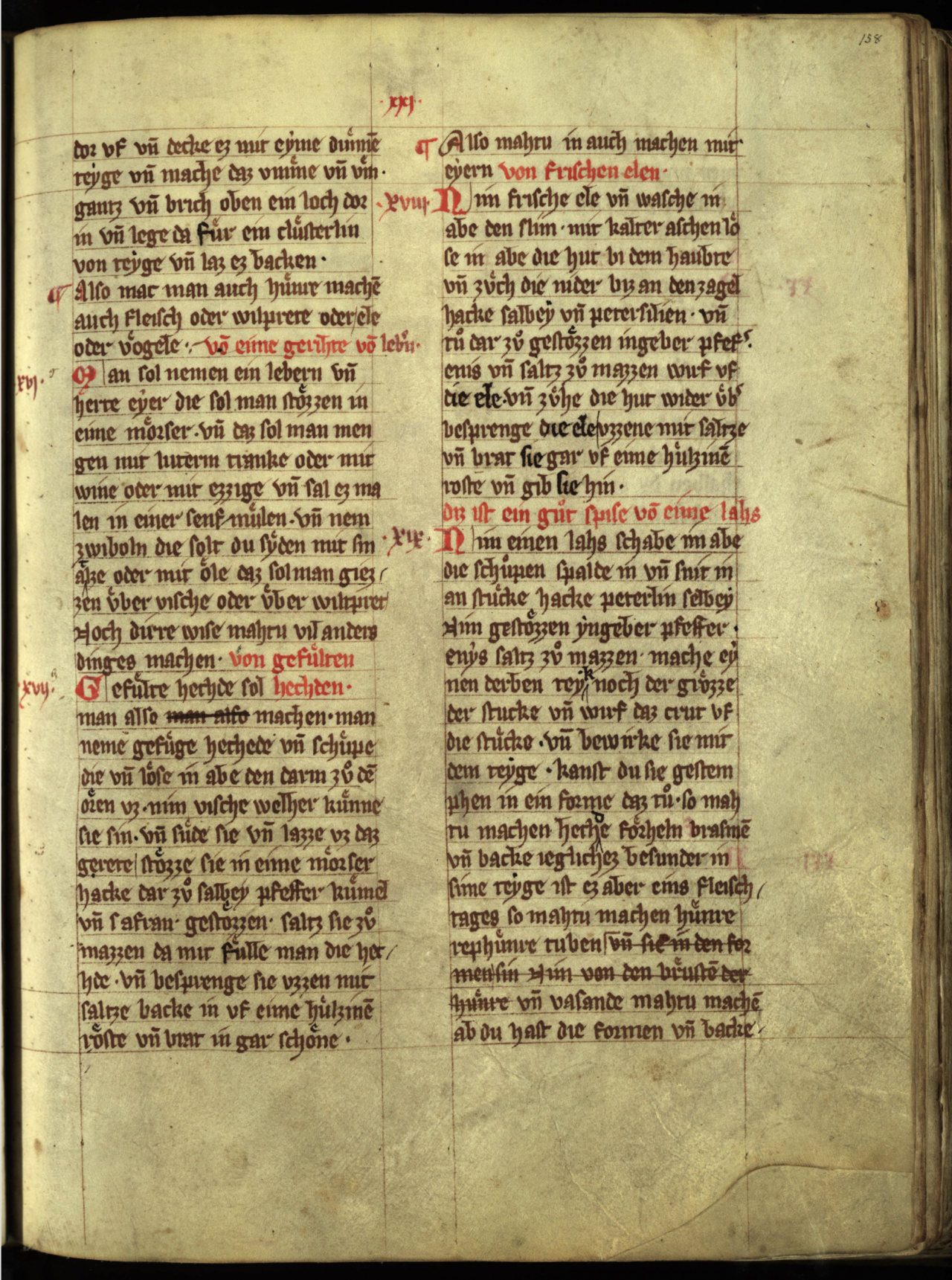
Gefilte fish likely originated in non-Jewish, German cooking. The earliest historical reference to gefuelten hechden (stuffed pikes) comes from Daz Buoch von Guoter Spise (The Book of Good Food), a Middle High German cookbook dating to circa 1350 CE. This dish consisted of poached and mashed pike flavored with herbs and seeds, stuffed back inside the fish skin, and then roasted. It was popular with German Catholics during Lent, when meat is forbidden. By the Middle Ages, stuffed fish had migrated into the cuisine of German and Eastern European Jews.
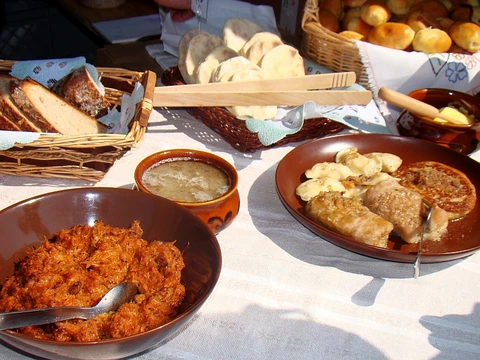
In Poland, gefilte fish is referred to as karp po żydowsku ('carp Jewish-style'). The preference for sweet gefilte with sugar was popular among Galician Jews from central Europe, while gefilte fish with black pepper was preferred by the more northern Litvak Jews. The boundary separating the two camps was dubbed 'the Gefilte Fish Line' by Yiddish linguist Marvin Herzog in the mid-1960s. Sweet gefilte fish with sugar in Galicia can be traced to the turn of the 19th century, when the first sugar beet factory opened in southern Poland.
Among religiously observant Jews, gefilte fish has become a traditional Shabbat food to avoid borer, one of the 39 activities prohibited on Shabbat. Borer would occur when one picks the bones out of the fish. Pre-made fish cakes such as gefilte fish obviate the need to perform such separation. A less common belief is that fish are not subject to ayin harah ('evil eye') because they are submerged while alive, so that a dish prepared from several fish varieties brings good luck.
Reader's Guide
Gefilte fish holds a significant place in Ashkenazi Jewish culinary and religious tradition. Its evolution from a labor-intensive stuffed whole fish to convenient patties or canned products reflects broader changes in Jewish cooking and food preservation. The dish serves as a cultural marker, with the sweet versus savory divide mapping onto ancestral origins in Galicia versus Lithuania, a distinction so notable that linguists coined the term 'Gefilte Fish Line.'
Religiously, gefilte fish became a Shabbat staple because it avoids the prohibition of borer (selecting bones from meat). It also carries symbolic meanings: the Hebrew word for fish, dag, has the numerical value of seven, the day of Shabbat, and fish are considered an aphrodisiac encouraging procreation on Friday night. The dish's commercial development—from the late 1930s brand Mother's to Manischewitz, Mrs. Adler’s, Rokeach, and others—made it widely available in cans and jars, often packed in fish broth jelly. A patent for this jelly was granted in 1963, enabling mass-market distribution. Today, gefilte fish remains an acquired taste, with low-salt, low-carbohydrate, and sugar-free varieties available.
Did You Know?
- The earliest known reference to gefilte fish is from a Middle High German cookbook dating to circa 1350 CE, where it was called gefuelten hechden (stuffed pikes).
- In Poland, gefilte fish is called karp po żydowsku, meaning 'carp Jewish-style,' and is eaten by some Polish Catholics on Christmas Eve and Holy Saturday.
- The boundary between sweet and savory gefilte fish preferences is known as 'the Gefilte Fish Line,' coined by Yiddish linguist Marvin Herzog in the mid-1960s.
- A patent for the jelly used in mass-market canned gefilte fish was granted on October 29, 1963, to Monroe Nash and Erich G. Freudenstein.
From Stuffed Pike to Shabbat Staple
The name gefilte fish comes from Yiddish and German roots meaning 'stuffed fish,' a label that hints at the dish's earliest form. The oldest known written record of a similar preparation appears in Daz Buoch von Guoter Spise, a Middle High German cookbook from around 1350, which describes gefuelten hechden—poached and mashed pike seasoned with herbs and seeds, reinserted into the fish's own skin, and roasted. This was a popular Lenten dish among German Catholics, who were forbidden meat during that season. Over time, the concept of stuffing ground fish back into its skin crossed over into the kitchens of German and Eastern European Jewish communities. By the sixteenth century, however, the tedious step of re-stuffing the intact skin had largely fallen out of favor. Cooks began shaping the seasoned fish paste into oval patties resembling quenelles or into round fish balls, a format that persists to this day. In Poland, the dish carries the colloquial name karp po żydowsku, or 'carp Jewish-style,' a reminder of its deep roots in the region's culinary landscape.
The Craft of Making Gefilte Fish
The modern preparation of gefilte fish begins with deboned fillets of carp, pike, mullet, or whitefish, though more recent recipes have embraced Nile perch and even salmon, which lends the finished product a faintly pink tint. Catfish is strictly excluded because it does not meet kosher dietary requirements. The fillets are ground into a fine paste and combined with a handful of supporting ingredients: eggs (though some traditional recipes omit them), breadcrumbs or matza crumbs, salt, spices, onions, carrots, and in some cases potatoes. This mixture is shaped into balls or oval quenelle-like patties and gently simmered in fish stock until set. In the past, the paste was sometimes cooked inside the intact skin of a whole fish, producing a loaf that was sliced into portions before serving. In the United Kingdom, a notably different approach prevails: the patties are typically fried rather than poached. When plated, the dish is almost always crowned with a thin slice of cooked carrot and accompanied by a sharp horseradish condiment known as chrain.
Faith, Flavor, and the Gefilte Fish Line
Within observant Jewish households, gefilte fish holds a special place at the Shabbat table. One practical reason is the prohibition of borer, one of thirty-nine forbidden labors in the Shulchan Aruch, which bars separating bones from flesh on the Sabbath. Because gefilte fish is already boneless, it sidesteps this restriction and is prepared on Friday and served cold. Beyond the legalistic, the dish carries layered symbolism: the Hebrew word dag, meaning fish, has a numerical value of seven, echoing the seventh day of rest. Sages also associated the scent of fish on the Shabbat table with encouragement for couples to 'be fruitful and multiply.' A folk belief holds that fish, living submerged, are shielded from the evil eye, a notion so powerful in Eastern Europe that it inspired the given name Fishel. The dish also maps onto regional identity. Yiddish linguist Marvin Herzog coined 'the Gefilte Fish Line' in the mid-1960s to describe the divide between Galician Jews, who favored a sweet, sugar-laced version, and northern Litvak Jews, who preferred a peppery preparation. The Galician sweetness traces to the first sugar beet factory in southern Poland around the turn of the nineteenth century, after which sugar permeated many local dishes.
From Kitchen to Canned Shelf
The late 1930s marked a turning point when Sidney Leibner, the son of a fish store owner, launched a ready-to-serve brand called Mother's, bringing gefilte fish out of the home kitchen and into commercial distribution. Soon other names followed, including Manischewitz, Mrs. Adler's, and Rokeach. The post-World War II industrial method typically shaped the ground fish into patties or balls, or wrapped a log of the mixture in wax paper before poaching or baking it. The finished product was sold in cans and glass jars, packed in a jelly derived from fish broth or in the broth itself. A critical innovation came on October 29, 1963, when Monroe Nash and Erich G. Freudenstein were granted a patent for that jelly, a development that made mass-market distribution of gefilte fish practical and widespread. Today, grocery shelves stock not only canned and jarred versions but also frozen logs of the dish. Sodium content in the commercial product runs relatively high, at roughly 220 to 290 milligrams per serving, though low-salt, low-carbohydrate, low-cholesterol, and sugar-free varieties now cater to health-conscious consumers. Despite its ubiquity, many still describe gefilte fish as an acquired taste, a flavor that rewards patience and familiarity.
Gallery

Frequently Asked Questions
Who is Gefilte fish?
Gefilte fish is a poached fish dish whose roots stretch back to medieval German kitchens, with the earliest known mention in a Middle High German cookbook dating to roughly 1350 CE. It later became a beloved staple of Ashkenazi Jewish home cooking, especially in the regions that are modern-day Poland.
What are Gefilte fish's powers/role?
Its job on the table is to open the meal as an appetizer, showing up most often during Shabbat dinners and major Jewish holidays like Passover. The dish is built from ground, deboned fish—carp, pike, whitefish, or similar—bound with eggs, breadcrumbs or matza crumbs, onions, carrots, and a warm spice blend, then gently poached.
How does Gefilte fish's story end?
By the sixteenth century, cooks had dropped the laborious step of stuffing minced fish back into a whole fish skin, and the seasoned mixture came to be shaped into quenelle-like patties or fish balls instead. On the plate, it is typically finished with a slice of cooked carrot and a dollop of horseradish relish called chrain.
Why is Gefilte fish important?
The dish anchors Shabbat and holiday tables in Ashkenazi Jewish tradition, giving families a shared culinary ritual that has been passed down for centuries. Regional taste preferences add a fun twist: Galician Jews leaned toward a sweeter version, while Litvak Jews favored a more savory preparation seasoned with black pepper.
What's Gefilte fish's secret ingredient?
The binding and depth of flavor come from eggs, breadcrumbs (or matza crumbs during Passover), grated onions, carrots, and a spice mix folded into the ground fish. The specific fish varies by household and region, with carp, pike, mullet, whitefish, and even salmon all appearing in traditional recipes.
More in Polish cuisine 1-24
Spotted an error? Know more?
This is a living reference — every entry is fact-audited, and reader corrections feed straight into our audit queue. Suggest an edit · See this site's audit record