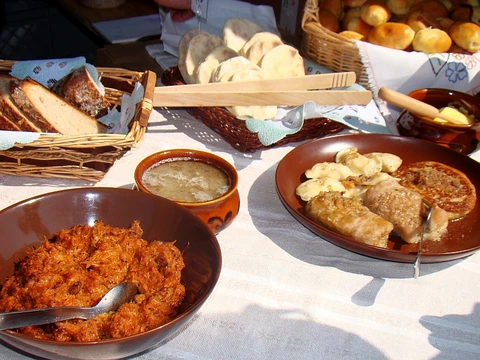
Braised sauerkraut
A Polish braised cabbage dish with bacon and mushrooms.

Wikipedia / Wikimedia Commons
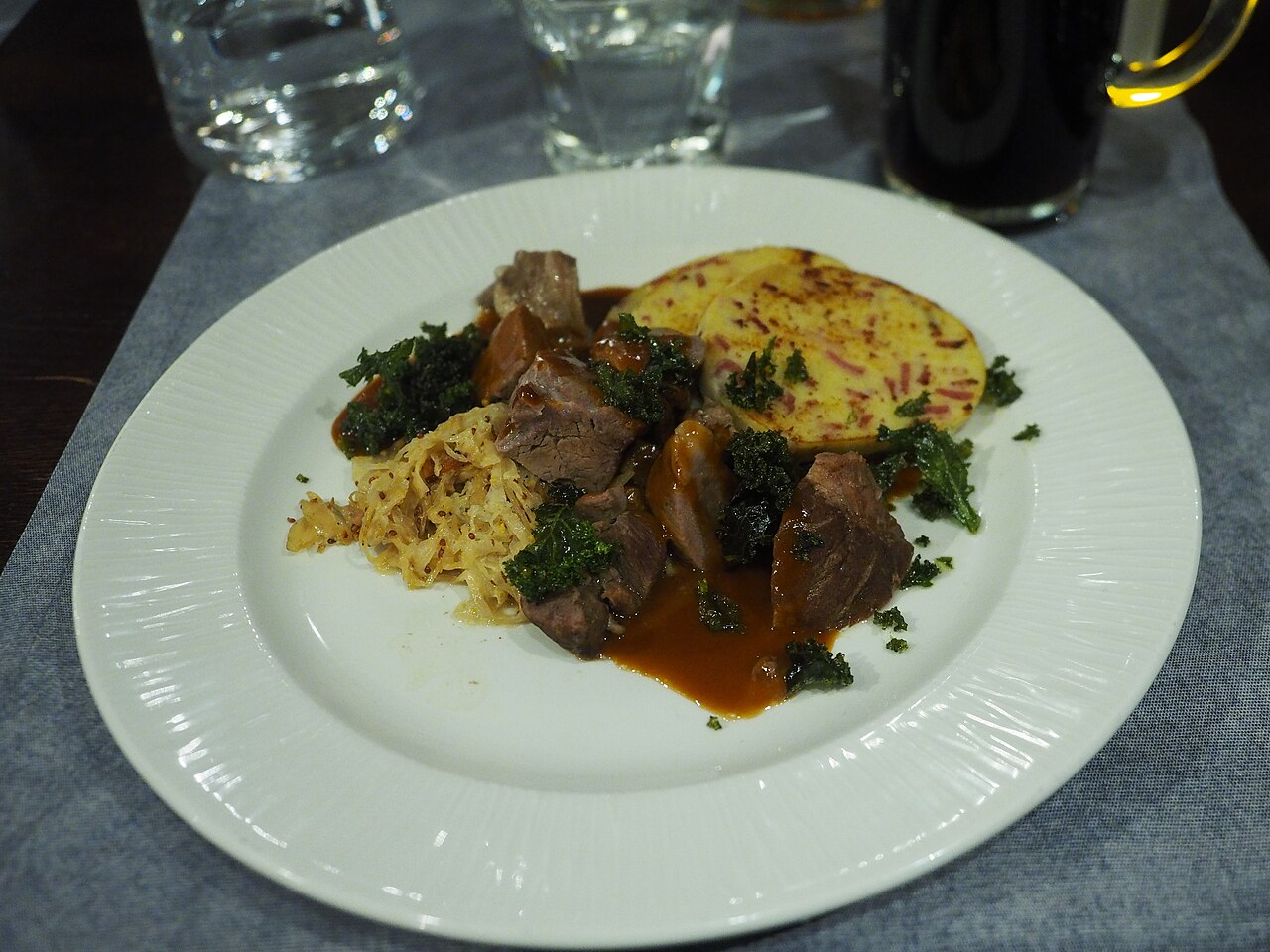
Braised sauerkraut, known in Polish as kapusta, is a traditional Polish dish made from braised or stewed sauerkraut or cabbage, often combined with bacon, mushrooms, onion, or garlic. It is seasoned with salt, pepper, and sometimes bay leaf, caraway seeds, sugar, paprika, or apples, and is typically served with boiled potatoes alongside pork, veal, or game meats.
- name
- Braised sauerkraut (kapusta)
- type
- Polish dish
- main_ingredients
- sauerkraut or cabbage, bacon, mushroom, onion or garlic
- common_seasonings
- salt, pepper, bay leaf, caraway seeds, sugar, paprika, apples
- typical_accompaniments
- boiled potatoes, pork chops, pork cutlets, veal, game meats
- notable_variation
- served thin like soup or thickened with flour to mashed-potato consistency
Lore & Background
Zasmażana kapusta, often simply called kapusta, is a Polish dish of braised or stewed sauerkraut or cabbage. It is prepared with bacon, mushroom, and onion or garlic, and seasoned with salt, pepper, and sometimes bay leaf, caraway seeds, sugar, paprika, and apples. The dish is traditionally served with boiled potatoes as an accompaniment for pork chops, pork cutlets, other pork dishes, veal, or game meats.
Reader's Guide
Kapusta holds a significant place in Polish cuisine as a versatile and comforting dish. Its preparation varies widely: in some homes it is served very thin, almost like a soup, while in others it is thickened with flour or cooked until nearly as thick as mashed potatoes. The dish is described as less sour in flavor compared to German sauerkraut. The primary ingredient, cabbage, is often pickled like sauerkraut and amplified with mushrooms, onions, and fatty pork—either rib meat, bacon, or occasionally smoked kielbasa. Almost always the dish contains a kind of roux. Its cultural resonance is noted in Herta Müller's novel *The Hunger Angel*, where a chapter deals with the protagonist's relationship to kapusta, which comes to represent both his life as a prisoner and his hopes for freedom.
Did You Know?
- Kapusta is the Polish word for 'cabbage'.
- The dish is sometimes served very thin, almost like a soup.
- It can be thickened with flour or cooked until nearly as thick as mashed potatoes.
- A chapter of Herta Müller's novel *The Hunger Angel* deals with the protagonist's relationship to kapusta.
Place in the Traditional Polish Table
A traditional Polish dinner unfolds across three distinct courses, and braised sauerkraut occupies a specific and important position within that structure. The meal opens with a soup—perhaps a rich meat broth or a tomato-based preparation—followed in some settings by an appetizer of herring, cured meats, or a chopped raw vegetable salad. It is at the main course stage that sauerkraut appears, serving as a vegetable accompaniment to the protein. The main plate typically centers on a piece of meat: a roast, a breaded pork loin cutlet, or a preparation of chicken. Sauerkraut sits on the plate alongside these proteins, sharing the table with other staple sides such as boiled potatoes, a grain porridge known as kasza, or, less frequently, rice. The entire sequence concludes with a dessert, ranging from a simple fruit compote to a poppy-seed pastry, a layered mille-feuille, or a cheesecake. Because traditional Polish dishes often demand lengthy preparation, and festive occasions like the Christmas Eve dinner or Easter breakfast can require several days of work, the sauerkraut that appears on the table is part of a deeply considered, multi-day culinary effort rather than a quick add-on.
Pairings with the Main Course
In the architecture of a Polish main course, braised sauerkraut is not a standalone feature but a deliberate companion to the protein that anchors the plate. The main course is built around meat, and the most common choices are a roast, a breaded pork loin cutlet, or a preparation of chicken. Polish cuisine as a whole is described as rich in meat—pork, chicken, and game feature prominently—and makes heavy use of butter, cream, eggs, and seasoning. Within that framework, sauerkraut provides a vegetable counterpoint to the richness of the meat and its accompanying sauces. It is listed in the same breath as other vegetable preparations that accompany the protein: a coleslaw-like shredded salad, root vegetables such as carrot, celeriac, and cooked beetroot dressed with lemon and sugar, and a salad known as mizeria. The presence of sauerkraut on the plate signals that the diner is experiencing the full, layered composition that Polish cooking intends, where the vegetable side is not an afterthought but an integral element of the main course's overall balance.
Among the Vegetable Accompaniments
Braised sauerkraut does not appear in isolation on a Polish table; it is one member of a small family of vegetable preparations that accompany the main course. In the traditional structure, the protein is served alongside a selection of vegetable sides, and sauerkraut is listed among them. Its companions in this role include a coleslaw-like shredded salad, a preparation of shredded root vegetables—carrot, celeriac, and cooked beetroot—dressed with lemon and sugar, and a salad called mizeria. Beyond these vegetable accompaniments, the plate is typically rounded out with a starch: boiled potatoes are the most common, a grain porridge called kasza is a close second, and rice appears less frequently. This grouping reveals a principle of Polish table composition: the main course is a composite, built from the interplay of meat, a vegetable element, and a grain or potato base. Sauerkraut, in its braised form, represents the tangy, fermented end of the vegetable spectrum, offering a textural and flavor contrast to the buttery, cream-rich preparations that characterize much of Polish cooking.
Within a Century-Old Culinary Tradition
Braised sauerkraut exists within a culinary tradition that has been shaping itself for roughly ten centuries. Polish cuisine is described as eclectic, its character forged by regional agricultural practices, historical trade routes, religious observance, and ongoing cultural exchange. The cuisine is broad in its pantry—vegetables, legumes, grains, mushrooms, and herbs all play significant roles alongside the meats that dominate the plate. The term "à la polonaise," borrowed from French, signals that when Polish-style techniques appear in other culinary traditions, they carry the weight of that long history. Traditional Polish dishes are noted for demanding lengthy preparation, and the most important festive meals—the Christmas Eve dinner on December 24 and the Easter breakfast—can require several days of work before the first course is served. In this context, a plate of braised sauerkraut is not merely a side dish; it is a small expression of a food culture that values patience, layering, and the careful assembly of a multi-course meal where every element, from the opening soup to the final dessert, has been given its due time and attention.
Gallery
Frequently Asked Questions
Who is Braised sauerkraut?
Kapusta is a beloved traditional Polish dish built around slow-braised sauerkraut or cabbage. It's the kind of deeply savory, home-style side that defines Polish comfort cooking.
What are Braised sauerkraut's powers/role?
At its heart, the dish layers sauerkraut or cabbage with rendered bacon, mushrooms, and aromatics like onion or garlic. A pinch of caraway, bay leaf, paprika, or even a grated apple adds complexity to the braise.
How does Braised sauerkraut's story end?
On the plate, it most often keeps company with boiled potatoes and a hearty cut of pork, veal, or game. In some kitchens the braise is stretched into a loose, soup-like consistency, while others thicken it with flour until it's dense and spoonable.
Why is Braised sauerkraut important?
It's a cornerstone of the Polish pantry because it turns humble, preserved cabbage into a rich, filling side that pairs with nearly any meat. Its presence at family meals and holiday tables spans generations.
What is Braised sauerkraut's notable variation?
The same base recipe can be served two very different ways: thin and brothy like a rustic soup, or thickened with flour to a consistency close to mashed potatoes. Both textures are considered perfectly authentic depending on the cook's preference.
More in Polish cuisine 1-24
Spotted an error? Know more?
This is a living reference — every entry is fact-audited, and reader corrections feed straight into our audit queue. Suggest an edit · See this site's audit record