Crucian carp
A European carp that survives winter by producing alcohol.
The crucian carp (Carassius carassius) is a medium-sized member of the carp family Cyprinidae, widely distributed across northern European regions from England to Russia, as far north as the Arctic Circle and south to central France and the Black Sea. Its name derives from the Low German karusse or karutze, possibly from Medieval Latin coracinus. It is native to England and not introduced, and serves as the type species for its genus, though this has caused taxonomic confusion with East Asian species.
- field
- Ichthyology
- known_for
- Surviving anoxic conditions via ethanol fermentation; deep-bodied morph as predator defense; type species of genus Carassius
- native_range
- Northern Europe (England to Russia, Arctic Circle to central France and Black Sea)
- typical_length
- 15 cm (5.9 in)
- maximum_length
- 64 cm (25 in)
- maximum_weight
- 3 kg (6.6 lb)
Lore & Background
The crucian carp inhabits lakes, ponds, and slow-moving rivers. Its body is described as 'golden-green shining color,' with young fish golden-bronze darkening to a dark green back, deep bronze upper flanks, and gold on lower flanks and belly, with reddish or orange fins. A distinguishing characteristic is a convexly rounded fin, unlike goldfish hybrids which have concave fins. Hybridization with domestic or feral goldfish has been verified in laboratory conditions, producing sterile or nearly sterile F1 hybrids that exhibit hybrid vigor, being more adept at finding food and evading predators, posing a possible threat to native populations.
Reader's Guide
The crucian carp is significant for its remarkable physiological adaptation: it can survive for weeks in anoxic conditions by converting lactate to ethanol, a facility highly unusual among vertebrates. This adaptation evolved over millions of years to endure winter ice cover that seals off atmospheric oxygen. The fish excretes ethanol into the water to avoid toxic accumulation. Additionally, when cohabiting with predatory fish, the population shifts from a sleek-bodied to a deep-bodied morphology that makes it harder for predators to swallow, though this morph is associated with compromised immune function and reduced growth rates. In Britain, it is a coarse fishing target, with a rod-caught record of 4 lb 14.0 oz (2.212 kg) landed in 2024. It is also kept in aquariums and water gardens, valued for cleaning up excrement to prevent nitrogen overload. In Poland, it is considered the best-tasting pan fish, traditionally served with sour cream; in Russia, it is used in borscht and fried with sour cream. FAO statistics treat Asian Carassius gibelio as a subspecies, so global production figures largely reflect Asian farming.
Did You Know?
- The crucian carp can survive anoxic conditions for up to 140 days experimentally by producing ethanol in muscle and liver tissues.
- When predators are present, crucian carp develop a deep-bodied form that makes them harder for predator fish to swallow.
- The British rod-caught record for crucian carp is 4 lb 14.0 oz (2.212 kg), landed on 30 October 2024.
- Hybrids between crucian carp and goldfish are sterile but exhibit hybrid vigor, potentially threatening native populations.
Range, Identity & Physical Character
The crucian carp (Carassius carassius) holds the distinction of being the type species for its entire genus, a taxonomic anchor that has, ironically, generated considerable confusion when classifying its East Asian relatives. Its name traces back to Low German karusse or karutze, with some etymologists linking it to the Medieval Latin coracinus, a term for a river fish. This medium-sized member of the Cyprinidae family commands a remarkably broad European range, stretching from the shores of England all the way to Russia, reaching the Arctic Circle in Scandinavian waters and dipping southward to central France and the Black Sea basin. It thrives in lakes, ponds, and slow-moving rivers, and has been confirmed as a native English species rather than an introduced one. In terms of build, the typical specimen measures around fifteen centimetres in length and seldom tops two kilograms, though a male reaching sixty-four centimetres and a published maximum weight of three kilograms have been documented. Young fish display a golden-bronze sheen that deepens with age into a dark green back, bronze upper flanks, gold along the belly, and reddish-orange fins. A convexly rounded dorsal fin distinguishes it from goldfish hybrids, which exhibit concave fins.
Morphological Plasticity & the Cost of Defence
Few freshwater fish demonstrate as dramatic a capacity for body-shape plasticity as the crucian carp. When sharing waters with predatory species, populations shift from a streamlined, sleek-bodied form to a noticeably deep-bodied morphology. This induced change is not cosmetic: the deeper, more compressed silhouette makes it physically difficult for a predator to accommodate the carp within its jaws, effectively turning the fish's own body into a mechanical defence. Yet this adaptation carries a significant biological cost. The deep-bodied form is not a fixed trait but a conditional response, and in predator-free environments it likely imposes survivability trade-offs. Research indicates that deep-bodied individuals exhibit compromised immune function, specifically a lower baseline level of natural antibodies compared to their sleeker counterparts. Growth rates are also reduced in the deep-bodied morph. In essence, the crucian carp pays for its anti-predator armour with a weakened immune system and slower development, a trade-off that underscores the evolutionary price of morphological flexibility.
Surviving Without Oxygen: The Ethanol Metabolism
Perhaps no single physiological trait makes the crucian carp more extraordinary than its ability to survive prolonged oxygen-free periods by producing ethanol through fermentation — a metabolic strategy extraordinarily rare among vertebrates. This adaptation is believed to have evolved over millions of years, driven by the reality of northern European winters: when surface ice seals a pond off from atmospheric oxygen, the fish beneath must find another way to stay alive. In winter, the crucian can sustain this fermentation-based metabolism for several weeks, and in laboratory settings specimens have been kept alive under fully anoxic conditions for one hundred and forty days. The process works best in the coldest water, even at zero degrees Celsius, because the low temperature suppresses metabolic demand. Biochemically, the pathway converts lactate to pyruvate, decarboxylates it to acetaldehyde, and hydrogenates that into ethanol, which the fish excretes into the surrounding water rather than accumulating to toxic levels. The liver is thought to be the evolutionary cradle of this process, though muscle tissues also participate. Goldfish share a more limited version of this capacity, but nothing approaches the crucian's remarkable endurance.
The Goldfish Entanglement & Conservation Concerns
The relationship between the crucian carp and the goldfish remains one of the most tangled in freshwater ichthyology. Some authorities regard the goldfish (Carassius auratus) simply as a cultivated breed domesticated from wild crucian stock, and the confusion is compounded by Carassius carassius serving as the type species for the entire genus. In practice, the most pressing consequence appears in competitive coarse fishing, where officials must distinguish a legitimate crucian from a 'brown goldfish variant' — a hybrid offspring. Several British rod-caught record bids have been rejected on precisely these grounds. The current British record stands at four pounds fourteen ounces, landed by Adam Broodbanks at Barham Syndicate in Suffolk in October 2024, surpassing Julian Barnes's 2021 mark from Surrey. Beyond the angling world, laboratory-verified hybridisation between crucians and domestic or feral goldfish produces viable F1 offspring that, while largely sterile, display striking hybrid vigour: superior foraging and predator evasion compared to either parent. This genetic contamination poses a genuine conservation concern for native populations. In aquaria and water gardens, crucians serve as ecosystem engineers, consuming organic waste and preventing nitrogen overload, though they remain commercially overshadowed by flashier species like koi and orfe.
Gallery
Frequently Asked Questions
What is crucian carp in Polish cuisine?
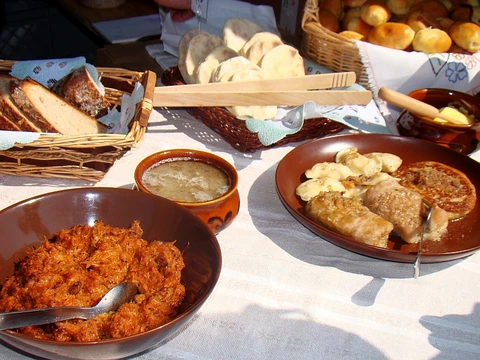
It is a small, deep-bodied freshwater fish from the carp family, native to northern European waters stretching from England to Russia. In Polish home kitchens it shows up as a humble whole-fried or vinegar-pickled dish, far less showy than the large common carp that dominates holiday tables.
What makes crucian carp so remarkable?
Its signature superpower is tolerating nearly oxygen-free winter ponds by shifting its muscle metabolism to ethanol fermentation, essentially brewing its own alcohol to keep cells functioning. No other common freshwater fish pulls off this trick, which is why it thrives in stagnant, ice-choked waters where rivals succumb.
How big does crucian carp get?
Most individuals sit around 15 cm, but exceptional specimens can stretch to roughly 64 cm and tip the scale near 3 kg. Its laterally compressed, deep-bodied shape is an evolutionary defense that makes it awkward for larger predators to swallow whole.
Where does crucian carp live?
It is a native inhabitant of northern European freshwater systems, found from the Arctic Circle south to central France and east to the Black Sea basin. In England it is indigenous rather than introduced, and it also serves as the type species that defines the genus Carassius in taxonomy.
Why does crucian carp matter in Polish culinary tradition?
Its small size and abundance in local ponds made it an everyday, low-cost fish for simple broths, whole-frying, or pickling in household kitchens. It filled the gap between raw ingredients and the grander carp dishes reserved for Christmas, giving ordinary Polish meals a reliable protein source for centuries.
More in Polish cuisine 1-24
Spotted an error? Know more?
This is a living reference — every entry is fact-audited, and reader corrections feed straight into our audit queue. Suggest an edit · See this site's audit record