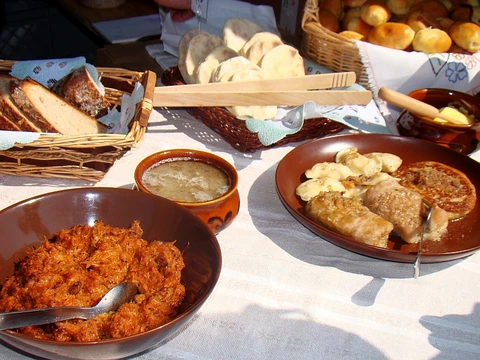
Biłgoraj pierogi
Traditional Polish baked dish from Biłgoraj Land.

Wikipedia / Wikimedia Commons
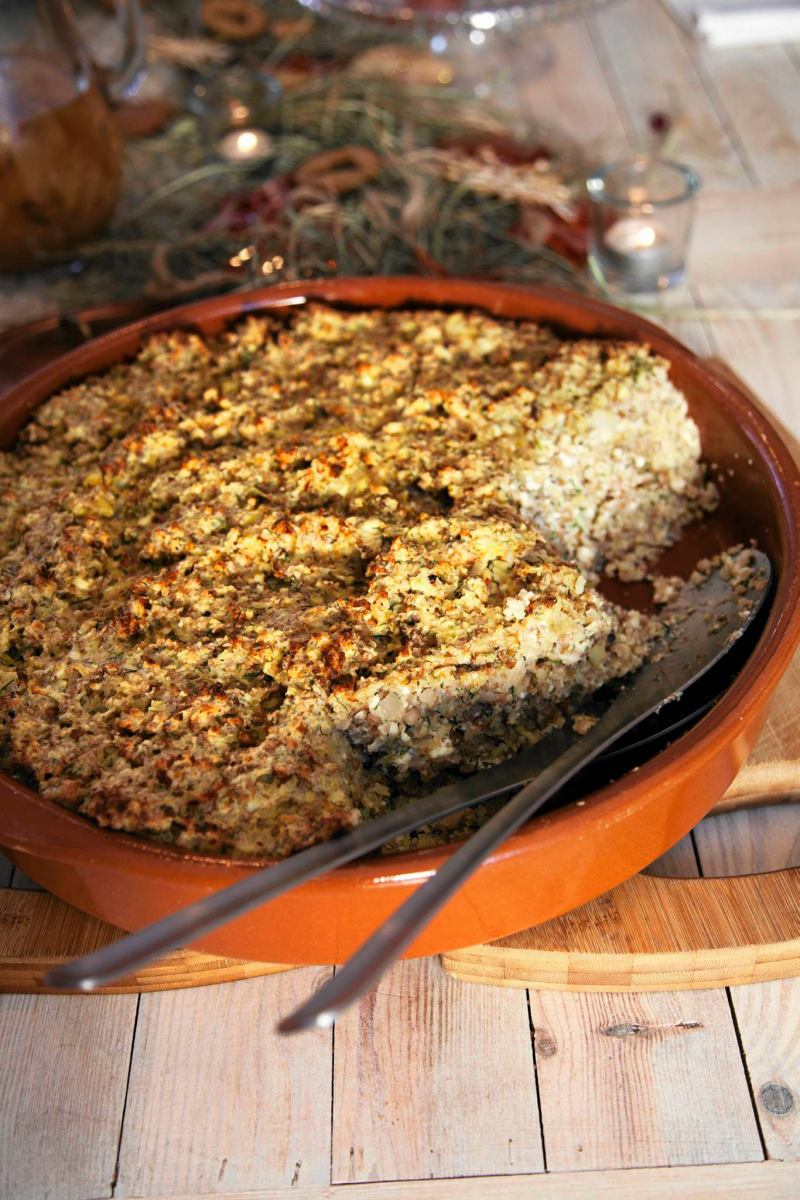
Biłgoraj pierogi (Polish: pieróg biłgorajski, piróg biłgorajski, krupniak) is a traditional Polish regional dish originating from Biłgoraj Land. It was formerly prepared for important celebrations and holidays and has been listed on the Polish Ministry of Agriculture and Rural Development's List of Traditional Products since October 4, 2005.
- origin
- Biłgoraj Land, Poland
- type
- Traditional baked dish
- main_ingredients
- Potatoes, quark, buckwheat groats, eggs, sour cream, fatback or lard, mint, salt, black pepper
- texture
- Solid, easy to break or crumble, resembling freshly cooked pâté
- serving_temperature
- Hot or cold
- listed_as_traditional_product
- Since October 4, 2005
Lore & Background
Biłgoraj pierogi are a regional specialty of Biłgoraj Land, traditionally made for important celebrations and holidays. The dish can be baked without a crust, called 'łysy' ('bald'), or with a yeast dough crust. The filling consists of cooked potatoes, quark, and cooked buckwheat groats, mixed with eggs, sour cream, fatback or lard, mint, and spices such as salt and black pepper.
Reader's Guide
The kneaded dough is formed into a rectangular or circular shape and baked in the oven. Optionally, it can be folded in a thin layer of yeast-based dough. Its texture is solid and crumbly, resembling freshly cooked pâté. It may be served hot or cold, with sour cream, milk, or butter. A similar Polish dish is kaszak, which is a bread roll filled with Biłgoraj pieróg. Since October 4, 2005, Biłgoraj pierogi have been recognized on the Polish Ministry of Agriculture and Rural Development's List of Traditional Products, underscoring their cultural and culinary significance in the region.
Did You Know?
- Biłgoraj pierogi can be baked without a crust, in which case it is called 'łysy' ('bald').
- The filling includes cooked potatoes, quark, cooked buckwheat groats, eggs, sour cream, fatback or lard, and mint.
- A similar Polish dish is kaszak, which is a bread roll filled with Biłgoraj pieróg.
- Since October 4, 2005, Biłgoraj pierogi are on the Polish Ministry of Agriculture and Rural Development's List of Traditional Products.
The Biłgoraj Pierogi – A Baked Eastern Classic
In eastern Poland, no baked dumpling carries more renown than the Biłgoraj pierogi. Where the vast majority of pierogi are simmered in water and then perhaps fried, this particular variety is distinguished by being baked directly in the oven, giving it a character all its own. The filling is a trio of humble, hearty ingredients: buckwheat, potatoes, and cheese, pressed into the unleavened dough wrapper before it goes into the heat. The result is a dish that has become a common and well-loved fixture of the Christmas table in Poland's eastern regions. It sits at the top of a broader category of baked pierogi that feature fillings ranging from cabbage and mushrooms to millet and buckwheat, but the Biłgoraj combination of those three specific ingredients has earned it the title of the most famous of the bunch. Its place in the holiday repertoire speaks to a tradition where the act of making and sharing these dumplings is as meaningful as the flavor on the plate.
From Peasant Table to Noble Feast
Pierogi began their life as peasant food, a practical way to wrap whatever was at hand in a simple unleavened dough and cook it in boiling water. Yet over the centuries the humble dumpling climbed every rung of Polish society until it was served at noble tables as readily as in village kitchens. By the seventeenth century, cookbooks documented pierogi as a staple of the Polish diet, and the tradition grew so elaborate that virtually every holiday demanded its own distinct variety. Weddings called for kurniki, a baked pie stuffed with chicken; mournings and wakes had their own special preparations; and the caroling season in January brought yet another form. In eastern Poland, baked pierogi became a beloved Christmas dish, filled with combinations of potatoes, cheese, cabbage, mushrooms, buckwheat, or millet. The dish also anchors public celebrations today, from markets to festivals, where dozens of sweet, salty, and spicy versions are offered to crowds. The 2007 Pierogi Festival in Kraków alone saw thirty thousand dumplings consumed in a single day, a testament to how far a peasant's boiled dough has traveled.
A Name Woven Through Slavic Tongues
The word pierogi is the Polish plural of pieróg, a single filled dumpling, and its roots stretch deep into the Proto-Slavic lexicon, where the ancestor form *pirъ simply meant 'feast.' That etymology links the dish to a shared linguistic heritage that predates every modern nation state. Cognates ripple outward across the Slavic world: Russian pirog and pirozhki carry the sense of 'pie' and 'small pies,' while Ukrainian varenyky, from the root var meaning 'boiling liquid,' names a related but distinct dumpling tradition. The family extends further still. Slovak bryndzové pirohy describes dumplings filled with sheep's milk cheese; Romanian colțunași traces back through Greek kaltsúni to Italian calzoni; Belarusian kolduny, Lithuanian virtiniai-koldūnai, and Polish kołduny all orbit the same concept. Even Mennonite and Doukhobor communities in Canada have their own spellings—varenikie, wareniki, pyrahi—carrying the name into new cultural contexts while preserving its ancient Slavic core.
Debated Roots and Enduring Legacy
No one can point to a single moment or place where pierogi were first pinched and dropped into a pot. The exact origin remains unknown and unverifiable, fueling ongoing debate. The most common theory traces dumplings back to China, with the dish spreading across Europe during the Middle Ages or later. Some credit Marco Polo's Silk Road expeditions with carrying the concept westward, drawing a line to Chinese mantou. Others invoke Saint Hyacinth of Poland, who supposedly brought the recipe from the Far East via Kievan Rus' in the thirteenth century. A separate theory points to Turkish culinary influence, noting a similar specialty called düs-vara in the territories of present-day Ukraine. What is verifiable is that by 1682, Poland's first published cookbook, Compendium ferculorum, already recorded the recipe, anchoring pierogi firmly in the written culinary record. Today the dish has crossed oceans, finding a home in Canadian and American kitchens, while in Poland it remains a culinary cornerstone from Biłgoraj's baked buckwheat-and-cheese version to the sweet berry-filled dumplings of a summer afternoon.
Gallery
Frequently Asked Questions
What exactly is Biłgoraj pierogi and how is it different from regular pierogi?
It is a traditional baked dish from southeastern Poland, also known locally as krupniak. Rather than being boiled like typical pierogi, it is baked into a dense, solid mass that crumbles easily, giving it a texture closer to a fresh pâté than a dumpling.
What ingredients go into Biłgoraj pierogi?
The core filling blends potatoes, quark, and buckwheat groats, all bound together with eggs and enriched with sour cream and fatback or lard. A touch of fresh mint, salt, and black pepper rounds out the flavor.
Where does Biłgoraj pierogi come from and when was it traditionally served?
It originates from the Biłgoraj Land region in southeastern Poland. For generations it was a special-occasion dish, prepared for major holidays and celebrations rather than everyday family meals.
How is Biłgoraj pierogi served and what is its texture like?
It has a firm, solid body that breaks apart or crumbles when cut, much like a freshly shaped pâté. You can eat it hot straight from the oven or slice it cold as a cold-cut-style plate.
Does Biłgoraj pierogi have any official recognition in Poland?
Yes, it has been inscribed on the Polish Ministry of Agriculture and Rural Development's List of Traditional Products since October 4, 2005. That designation formally acknowledges its deep roots in the Biłgoraj region's culinary heritage.
More in Polish cuisine 1-24
Spotted an error? Know more?
This is a living reference — every entry is fact-audited, and reader corrections feed straight into our audit queue. Suggest an edit · See this site's audit record