Baleron
Polish cold cut from cured, smoked boneless pork neck.

Wikipedia / Wikimedia Commons
Baleron is a Polish cold cut made from cured and smoked boneless pork neck. After ham, it is the second most valued cold cut in Poland.
- type
- cold cut
- origin
- Poland
- main ingredient
- boneless pork neck
- preparation
- dry-cured, brined 8–10 days, smoked, cooked
- appearance
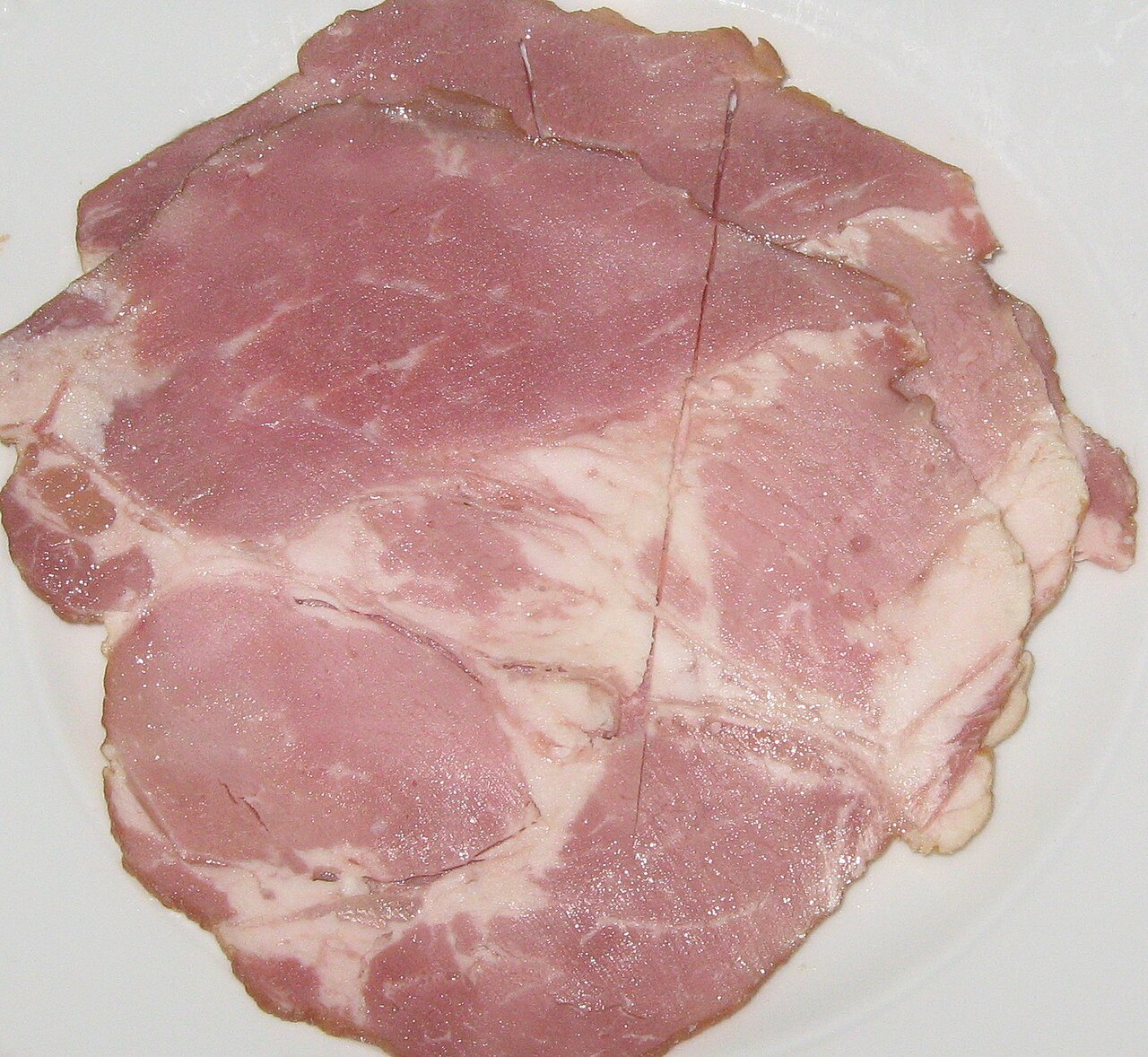
- marbled cross-section, brown with dark cherry shade
- status
- second most valued cold cut in Poland after ham
Lore & Background
Baleron is prepared by dry-curing boneless pork neck, then immersing it in brine for 8–10 days. After draining, it is stuffed into a casing, smoked in warm smoke, cooked, and cooled. The cross-section of the final product is marbled meat. Polish sources describe a more complicated process than the summary in the Encyclopedia of Meat Sciences.
Reader's Guide
Baleron holds a significant place in Polish cuisine as the second most valued cold cut after ham. Its preparation involves a multi-step process of dry-curing, brining, smoking, and cooking, resulting in a marbled, dark cherry-brown product. Several balerons have been registered as protected traditional foods by the Polish Ministry of Agriculture and Rural Development, including smoked baleron from Masurian butcher shops (2008), baleron nadwieprzański (2008), smoked baleron from Proszówki (2014), smoked baleron from Wisznice (2016), and baleron from Płock (2019). The etymology of the word is disputed: older Polish dictionaries derive it from the French 'paleron' (chuck steak), while newer dictionaries derive it from German 'Ballen-rolle'. This cold cut is typically smoked in a smokehouse fired with alder wood, giving it a distinctive flavor and appearance.
Did You Know?
- Baleron is made from boneless pork neck.
- It is the second most valued cold cut in Poland after ham.
- The word's origin is disputed between French 'paleron' and German 'Ballen-rolle'.
- Several balerons are registered as protected traditional foods by the Polish Ministry of Agriculture and Rural Development.
A Place at the Polish Table
Baleron occupies a distinguished position in Polish culinary tradition as a cold cut crafted from boneless pork neck that has been cured and smoked. While it may not enjoy the same international recognition as some other smoked meats, within Poland it holds a place of genuine prestige. Specifically, it ranks as the second most valued cold cut in the country, trailing only behind ham in the hearts of Polish diners. This is no minor distinction in a culture where pork products form the backbone of many traditional dishes. The meat itself comes from the neck region of the pig, with all bones carefully removed before the curing and smoking process begins. The result is a product that sits comfortably on the table as a ready-to-eat delicacy, bridging the gap between everyday sustenance and something approaching a specialty. Its position as a recognized pillar of Polish meat cuisine underscores how deeply regional and national food identities can be shaped by a single well-executed preparation of a common cut of meat.
The Art of Curing and Smoke
The transformation of raw pork neck into finished baleron follows a multi-stage process that rewards patience and precision. According to the Encyclopedia of Meat Sciences, the meat is first dry-cured, then submerged in a brine solution for a period of eight to ten days. After draining, the meat is stuffed into a casing before undergoing warm-smoke treatment. The final steps involve cooking and cooling to set the texture. The cross-section of the finished product reveals a beautifully marbled pattern of meat. Polish sources, however, describe an even more intricate sequence of steps than this summary suggests, implying that local practitioners have refined the technique well beyond what a general reference might capture. Descriptions of the ideal product paint a vivid picture: a brown exterior tinged with dark cherry, a dark pink interior when sliced, a slightly juicy and soft consistency, and a distinctly salty flavor. The smoking itself is specified as requiring an alder-wood-fired smokehouse, a detail that speaks to the importance of wood species in shaping the final taste.
A Word with Borders
The very name baleron carries a story of linguistic migration across Central Europe. Older Polish dictionaries traced the term back to the French word paleron, which refers to a chuck steak. This etymology suggests a French culinary influence on Polish meat nomenclature, perhaps arriving through trade or cultural exchange. However, newer dictionaries have revised this origin, instead linking the word to the German compound Ballen-rolle. This shift in scholarly consensus reflects how etymological understanding evolves as linguists refine their methods and reconsider connections between languages. The fact that two distinct European linguistic traditions, French and German, have both been proposed as the source of this Polish word highlights the layered cultural history of the region. A single cold cut thus becomes a small window into centuries of cross-border culinary and linguistic exchange, where names travel as easily as recipes and techniques do between neighboring food traditions.
Guardians of Tradition
Poland has taken formal steps to protect its baleron heritage by registering several regional varieties as protected traditional foods under the Ministry of Agriculture and Rural Development. The first two registrations came in 2008: one for smoked baleron produced in Masurian butcher shops, and another for baleron nadwieprzański, tied specifically to the Wieprz River area. Subsequent years brought additional protected designations, including smoked baleron from Proszówki in 2014, smoked baleron from Wisznice in 2016, and baleron from Płock in 2019. This staggered timeline shows a growing institutional commitment to preserving distinct local preparations. The protected status is not merely bureaucratic; it enforces specific production standards, including the requirement that smoking take place in a smokehouse fired with alder wood. By anchoring each variety to a particular town or river valley, Poland ensures that baleron remains a product of place, not just a generic category of cured pork.
Gallery
Frequently Asked Questions
What exactly is Baleron?
Baleron is a traditional Polish cold cut made from boneless pork neck that has been cured and smoked. It's a familiar sight on deli counters across Poland and a go-to slice for sandwiches.
What meat goes into Baleron?
The product is built entirely around boneless pork neck, which gives it a richly marbled cross-section. No other cuts or fillers are part of the standard recipe.
How is Baleron actually prepared?
The pork neck is dry-cured first, then brined for roughly eight to ten days. After that it goes through smoking and a final cooking step before it's ready to slice.
What does a slice of Baleron look like?
You'll see a marbled pattern with a brown base and a dark cherry undertone running through the meat. That coloring is a direct result of the curing and smoking stages.
Where does Baleron rank among Polish cold cuts?
It holds the number-two spot in Poland, sitting just behind ham in terms of how highly deli shoppers value it. Many Poles treat it as a premium pick for charcuterie boards and open-faced sandwiches.
More in Polish cuisine 1-24
Spotted an error? Know more?
This is a living reference — every entry is fact-audited, and reader corrections feed straight into our audit queue. Suggest an edit · See this site's audit record