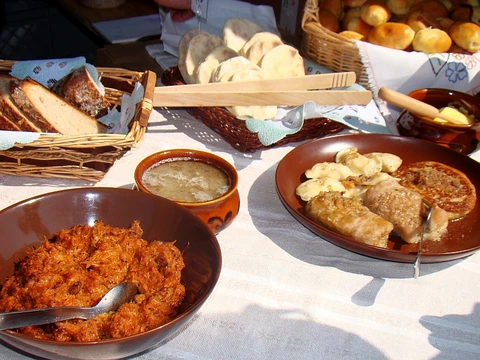
Christmas wafer
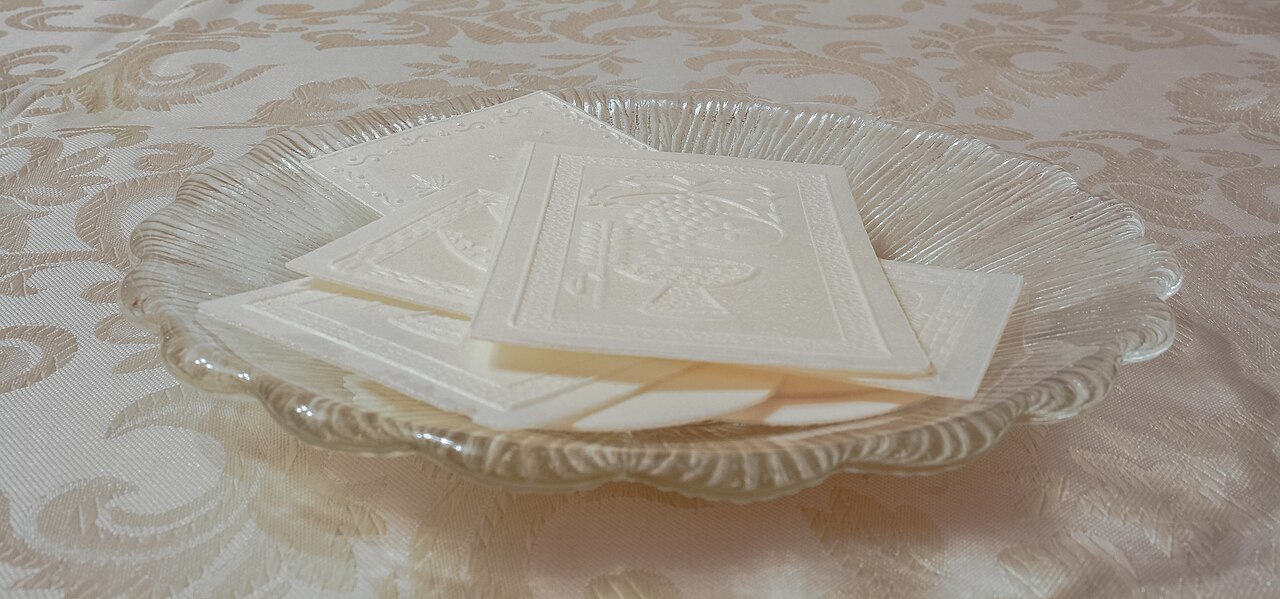
A Catholic Christmas wafer shared on Christmas Eve in Central Europe.

Wikipedia / Wikimedia Commons
The Christmas wafer—known as *opłatek* in Poland, *kalėdaitis* in Lithuania, and *oblátka* in Slovakia—is a Catholic tradition observed in Poland, Lithuania, Moravia, and Slovakia. It takes place during the Christmas Eve meals of Kūčios (Lithuania) and Wigilia (Poland) on December 24. These unleavened wafers are made only from wheat flour and water, shaped into thin rectangles, and are chemically the same as the altar bread used for the Eucharist in Roman Catholic Mass. The wafers are stamped with Christmas imagery, such as the nativity scene, Mary with the infant Jesus, or the Star of Bethlehem.
During the Christmas Eve meal, the family gathers at the table. The oldest member starts by breaking off a piece from a large wafer, then passes it to another person while offering a prayer for loved ones. This continues until everyone has a piece. Each family member then exchanges wishes with every other person, breaking off and eating a piece from the other’s wafer.
The custom began in Poland in the 10th century and remains a cherished tradition among people of Polish ancestry worldwide. In Poland and parts of Central Europe, wafers are sometimes dyed and used as decorations, or sent as small tokens with greeting cards to absent loved ones. The wafer symbolizes family unity, seen as a key pillar of society, as well as forgiveness and reconciliation. The father is considered the link in an unbroken chain of “One Body, One Bread, One Christ, and One Church,” with other family members joining him.
In Lithuania, before the Kūčios meal, families share *kalėdaitis* (also called *plotkelė*, *paplotėlis*, *plokštainėlis*, or *Dievo pyragai*, depending on the region). A plate holds as many wafers as there are diners. Each person receives a piece. The head of the family—usually the oldest or the father—offers a wafer to a family member with a Christmas wish. The recipient responds, “God grant that we are all together again next year,” and breaks off a piece. They then offer a piece of their own wafer in return. The head of the family repeats this with every person at the table, after which all diners exchange greetings and wafer morsels.
The tradition traces back to early Christianity (see Antidoron) and is seen as a non-sacramental preview of receiving the Holy Eucharist. As a Christmas custom, the *opłatek* originated in Poland and spread widely by the 17th century. I
- Also known as
- kalėdaitis, plotkelė, paplotėlis, plokštainėlis, Dievo pyragai, oblátka
- Region
- Poland, Lithuania, Moravia, Slovakia
- Observed on
- December 24 (Wigilia in Poland, Kūčios in Lithuania)
- Composition
- Unleavened wheat flour and water
- Symbolism
- Unity of family, forgiveness, reconciliation
- Origin
- Poland in the 10th century
- Related to
- Antidoron, Holy Eucharist
Lore & Background
Before partaking of the Christmas Eve meal, the family gathers around the table. The eldest member holds a large wafer and breaks off a piece to begin the ritual. The remaining wafer is passed on to another member while a prayer for loved ones is said. This continues until everyone at the table has a piece of the wafer. Finally, each family member gives wishes to every other family member, consuming a piece of wafer broken off of the wafer piece of the person to whom they were giving their wishes.
In Lithuania, before the Kūčios meal starts, families share kalėdaitis. A plate with as many wafers as there are persons participating in the meal is placed in the center of the table. Each member of the family is given a piece of unleavened wafer. The head of the family, typically the oldest person present or often the father, then takes a wafer and offers it to a family member wishing them a Happy Christmas. The family member responds, 'God grant that we are all together again next year,' and breaks off a piece of wafer. The head of the family then offers their wafer to every family member or guest at the table.
The tradition traces its origins to the times of early Christianity (see Antidoron) and is seen as a non-sacramental foreshadowing of the liturgical partaking of the Holy Eucharist. As a Christmas custom the opłatek originated in Poland and was spread widely as far back as the 17th century. It was part of the szlachta's (Polish nobility) culture and the custom had spread throughout the Polish–Lithuanian Commonwealth and neighbouring countries. In the 19th century, in the aftermath of the partitions of Poland, it gained patriotic subtext, as the common wish during sharing of opłatek became the wish for Poland's regaining its independence.
Reader's Guide
The Christmas wafer holds deep cultural and religious significance in Poland, Lithuania, Moravia, and Slovakia. It symbolizes the unity of the family, which many consider to be the main pillar of society. According to beliefs, the bond of unity should exist between family members; the father is seen as the link in the unbroken chain of One Body, One Bread, One Christ, and One Church, while other family members join him in this eternal procession. The wafer also symbolizes forgiveness and reconciliation. In Poland and some parts of Central Europe, these Christmas wafers are dyed and used as ornaments. They are also sent as small trinkets with greeting cards to loved ones who are away from home. The breaking of the Christmas wafer is a custom that began in Poland in the 10th century and is practiced by people of Polish ancestry around the world. It is considered the most ancient and beloved of Polish traditions. In the 20th century, the opłatek custom went beyond families and gained another meaning: the meeting of present or past co-workers or students. The tradition is seen as a non-sacramental foreshadowing of the liturgical partaking of the Holy Eucharist, and its spread from the 17th century onward was tied to the Polish nobility and the Polish–Lithuanian Commonwealth.
Did You Know?
- The Christmas wafer is identical in composition to the altar bread that becomes the Eucharist at Mass in the Roman Catholic Church.
- In Lithuania, the wafer is also called plotkelė, paplotėlis, plokštainėlis, or Dievo pyragai depending on the region.
- The custom of breaking the Christmas wafer began in Poland in the 10th century.
- In the 19th century, the common wish during sharing of opłatek became the wish for Poland's regaining its independence.
A Recipe of Radical Simplicity
The Christmas wafer stands apart from the broader wafer family through its austere ingredient list: nothing beyond wheat flour and water. Where a typical wafer might be crisp, sweet, and thin—often carrying a waffle surface pattern or a manufacturer's insignia—the Christmas wafer strips the formula down to its barest elements. This minimalism is not a limitation but a deliberate choice, setting the wafer apart from the chocolate-coated, lemon-flavored, or cream-filled variants that dominate commercial confectionery. The surface, rather than bearing a generic waffle grid or a brand logo, is pressed with religious scenes that give each piece a devotional character. In Polish, this distinction is baked into the language itself: the Christmas wafer is called opłatek, a term derived from the Latin oblatum, while the word wafel is reserved for the ordinary, everyday wafer. The naming alone signals that this is not a snack to be nibbled in passing but a piece of bread with a specific ceremonial purpose.
A Catholic Christmas Eve Tradition
The Christmas wafer is rooted in the Roman Catholic liturgical culture of Central Europe, where it has become a fixture of Christmas Eve celebrations in Polish, Slovak, Lithuanian, and Italian households. It occupies a distinctive place in the Christian symbolic landscape: unlike the communion wafer, which is an unleavened bread consumed as part of the sacrament of communion, the Christmas wafer carries no sacramental value. It is, in the words of the tradition itself, a symbolic bread. Yet its presence at the Christmas Eve table is no less meaningful for lacking formal liturgical status. The wafer's patterns, often depicting religious scenes, tie the domestic celebration to the broader narrative of the faith. Across the four national traditions that observe it, the wafer serves as a tangible link between the sacred story being commemorated and the family gathered around the table, transforming a simple disc of wheat and water into a vessel of shared devotion.
Breaking Bread, Making Wishes
At the heart of the Christmas wafer tradition is a gesture of communal bonding. The wafer is meant to be shared among guests, and the act of eating bread together is understood to emphasize and reinforce the close relationships between those present. The gesture carries an inherently positive meaning, a quiet affirmation of togetherness at the most sacred moment of the year. Beyond the simple sharing, participants often attach additional wishes to the moment, turning the breaking of the wafer into a small ritual of hope and goodwill. This social function distinguishes the Christmas wafer from other wafer traditions around the world—the Argentine and Latin American oblea, eaten as a dessert with milk caramel or condensed milk between two pieces; the Egyptian freska, a honey-syrup sandwich sold only on summer beaches; the Scottish pink wafer, a crème-filled confection. None of those carry the same weight of familial obligation and collective blessing that the opłatek brings to a Christmas Eve table.
A Wafer Among Wafers
The Christmas wafer exists within a vast global family of thin, flat, light biscuits, and understanding its place requires seeing the wider landscape. Wafers come in countless forms: crisp and sweet, patterned with waffle grids or manufacturer insignia, rolled into tubes like piroulines and barquillos, or sandwiched with chocolate as in Kit Kat and Toffee Crisp. In the spa towns of the Czech and Slovak Republics—Piešťany, Karlovy Vary, Mariánské Lázně—special lázeňské oplatky are produced, while Hungary's Molnárkalács, a round hard biscuit decorated with folk symbols and pressed with a tool called the sütővas, offers a cousin tradition. The Christmas wafer, with its wheat-and-water simplicity and religious imagery, sits at a different point on this spectrum. It is neither a confection to be decorated onto ice cream nor a garnish for sweet dishes. It is bread in the most literal sense, pressed thin, patterned with sacred scenes, and reserved for one specific night each year.
Gallery
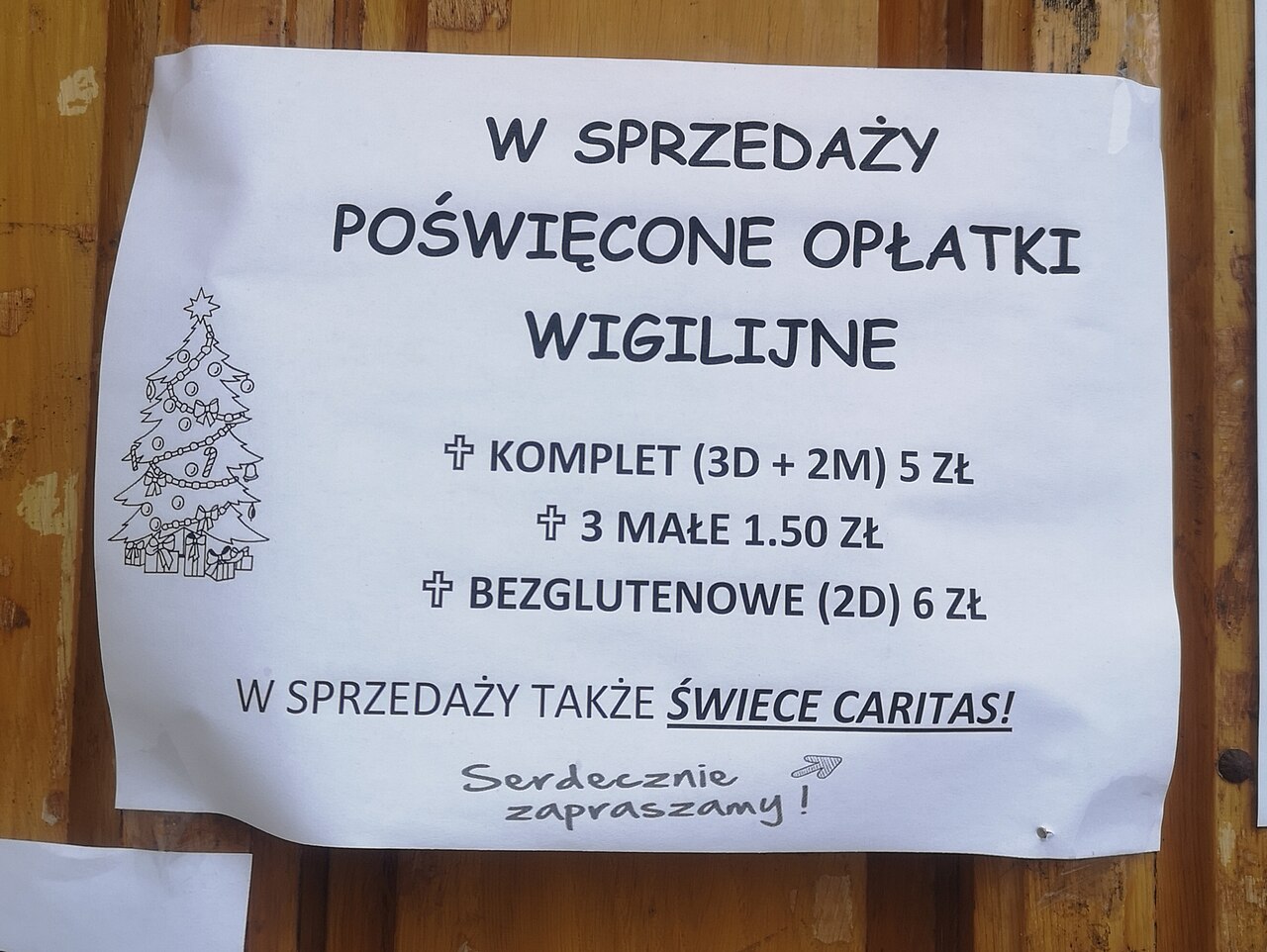
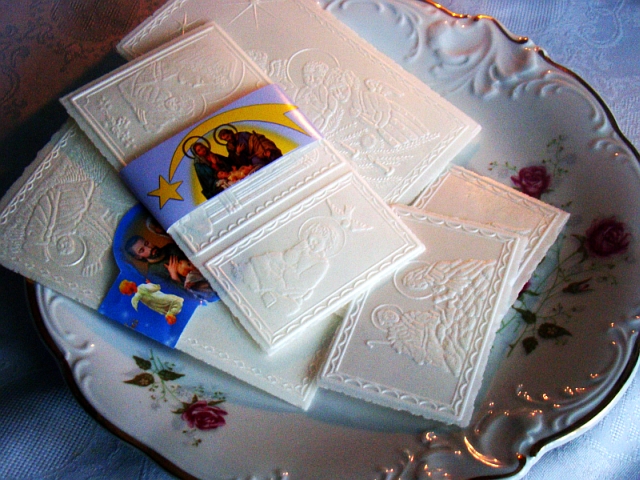
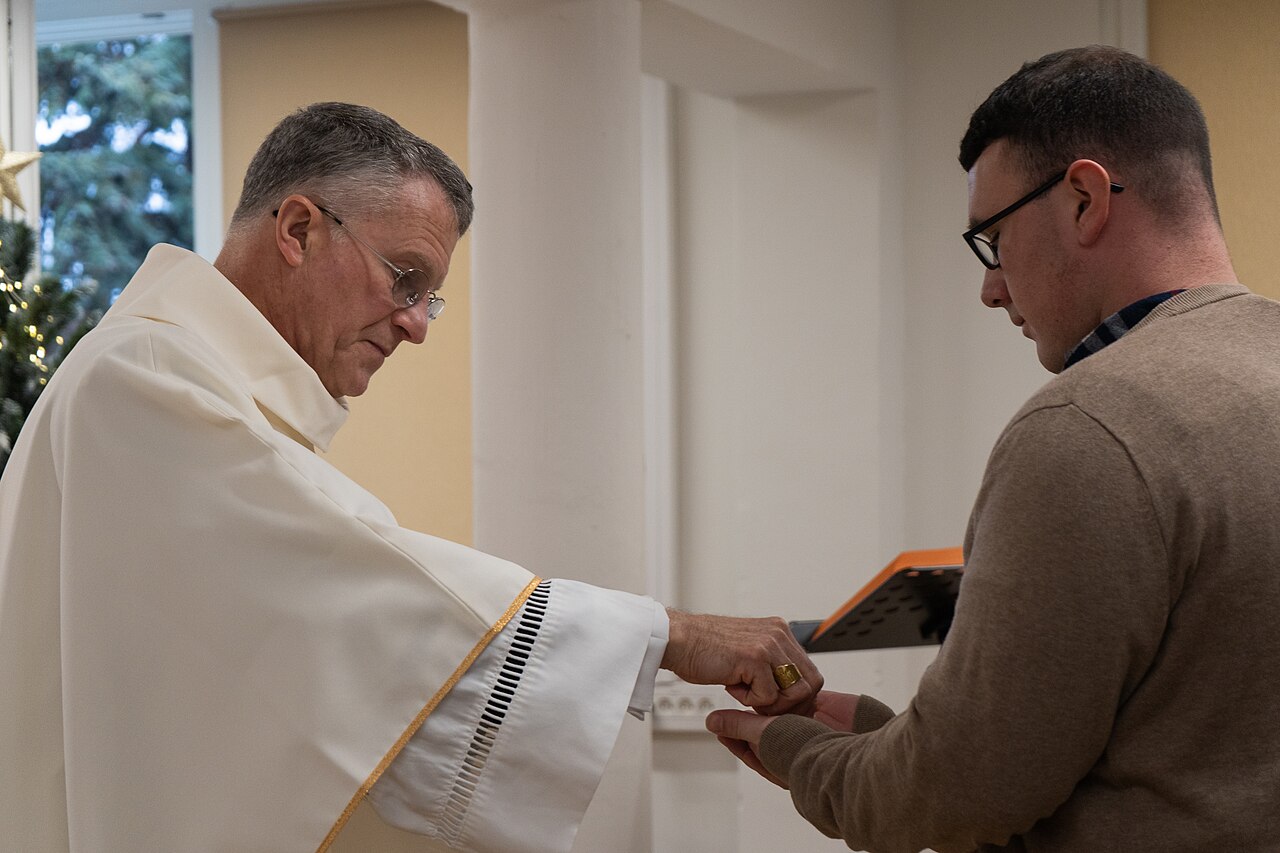
Frequently Asked Questions
What exactly is the Polish Christmas wafer (opłatek)?
It is a thin, unleavened rectangle made solely from wheat flour and water, stamped with festive imagery such as the nativity scene or the Star of Bethlehem. Chemically, it is identical to the altar bread used in the Roman Catholic Eucharist.
When and where is the opłatek tradition observed?
The wafer is broken and shared during the Christmas Eve dinner, known as Wigilia in Poland and Kūčios in Lithuania, on December 24. The custom extends across Poland, Lithuania, Moravia, and Slovakia, where it goes by local names like kalėdaitis and oblátka.
What does the opłatek ritual symbolize for the family?
Each member takes a piece of the wafer and exchanges blessings, turning the moment into a rite of unity, forgiveness, and reconciliation. It is a Catholic devotional practice meant to draw the household together before the holiday meal begins.
Where did the Christmas wafer tradition originate?
The custom traces back to Poland in the 10th century, where it first emerged as part of the Catholic Christmas Eve observance. It later spread to neighboring regions, taking on local names and slight variations in practice.
How does the opłatek differ from the Eucharistic host used in Mass?
Although both are made from the same unleavened wheat-and-water dough, the Christmas wafer carries stamped holiday imagery and serves a family-blessing role rather than a sacramental one. It is a devotional, communal practice instead of a liturgical rite.
More in Polish cuisine 1-24
Spotted an error? Know more?
This is a living reference — every entry is fact-audited, and reader corrections feed straight into our audit queue. Suggest an edit · See this site's audit record