Bagel
Boiled-then-baked ring bread from Polish Jewish tradition.

Wikipedia / Wikimedia Commons
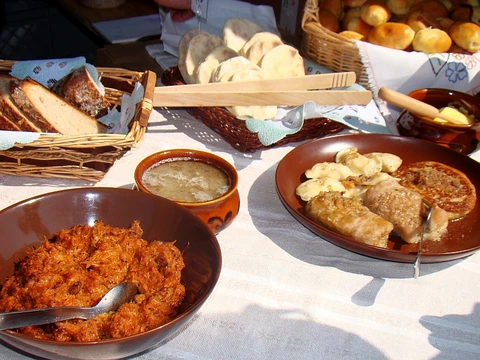
A bagel is a bread roll originating in the Jewish communities of Poland, traditionally made from yeasted wheat dough shaped into a ring, boiled, and then baked. It has been associated with Ashkenazi Jews since the 17th century and is now a popular bread product in North America and Poland.
- first mentioned
- 1610 in Kraków, Poland (Polish household inventory or similar record)
Lore & Background
The bagel likely originated in the Jewish communities of Poland, possibly derived from German pretzels. The first known mention of the Polish word 'bajgiel' occurs in Kraków in 1610, where the food was given as a gift to women in childbirth. The name derives from the Yiddish word 'beygal', from the German dialect word 'beugel', meaning 'ring' or 'bracelet'.
Bagels were brought to the United States by immigrant Polish Jews, with a thriving business developing in New York City controlled for decades by Bagel Bakers Local 338. Automation began with Daniel Thompson's first commercially viable bagel machine in 1958; Harry Lender, his son Murray Lender, and Florence Sender leased this technology and pioneered automated production and distribution of frozen bagels in the 1960s. Pre-sliced bagels were popularized by Murray Lender in the 1960s, though no earlier commercial introduction is documented in standard sources. The combination of lox and cream cheese on a bagel became popular in the mid-20th century, but the specific 'bagel brunch' with those toppings was not a widespread phenomenon around 1900.
Reader's Guide
The bagel's significance lies in its long history as a distinctive boiled-then-baked bread, first documented in 1610 in Kraków, and its evolution from a regional Jewish staple to a globally recognized food. Its design—a ring with a hole—allows even cooking and easy handling on strings or dowels. The bagel's legacy includes its central role in Ashkenazi Jewish culture and its spread to North America, where it became a symbol of New York City cuisine. The development of automated production and frozen distribution in the 1960s transformed it into a mass-market product. Variations such as New York style (boiled in salted water, cold-fermented) and Montreal style (boiled in honey-sweetened water, wood-fired) reflect regional adaptations. The bagel's size has increased over time, from about 2 ounces in the early 20th century to around 6 ounces by 2003 in Manhattan. Debates over toasting—with traditionalists arguing fresh bagels should never be toasted—highlight its cultural importance. The bagel remains a versatile food, sold fresh or frozen in many flavors, and continues to be associated with Jewish communities and urban food culture.
Did You Know?
- The bagel was first mentioned in 1610 in a Polish household inventory or similar record in Kraków, Poland.
- Bagels are traditionally boiled in water for 60–90 seconds before baking, giving them a dense, chewy texture.
- The average bagel sold on a Manhattan coffee cart in 2003 weighed around 6 ounces (170 g), up from about 2 ounces (60 g) originally.
- Pre-sliced bagels were popularized by Murray Lender in the 1960s, but no earlier commercial introduction is documented in standard sources.
Ancient Rings to Kraków's Ovens
Ring-shaped breads prepared by boiling before baking stretch back centuries across Europe and western Asia. In the 10th century, the Arabic cookbook Kitab al Tabikh already referenced ka'ak, a boiled-then-baked ring bread, and a full recipe appeared in the 13th-century Kitab al Wusla ila al Habib. In Poland, the obwarzanek—a similar ring-shaped loaf—was being produced by Kraków's baker's guild as early as the 13th century, with royal household records from 1394 confirming its use during Lent. The bagel's specific arrival in Kraków remains debated. One theory credits Bona Sforza, the Italian-born queen who married Sigismund the Old and ruled Poland from 1518 to 1548, with carrying the recipe from Bari. Another suggests German-speaking immigrants introduced pretzel-making techniques that evolved into the local form. By 1610, the word bajgiel appeared in Kraków's community regulations, where the bread was recorded as a gift presented to women in childbirth. The name itself traces to the Yiddish beygal, borrowed from the German dialect beugel, simply meaning "ring" or "bracelet." Through the 16th and early 17th centuries, the bajgiel cemented itself as a daily staple of Polish kitchens.
The Discipline of Dough and Fire
The traditional bagel demands a stiff, high-gluten wheat dough—hydration sits around 50 to 57 percent, placing it among the toughest bread doughs in existence. The base recipe is deceptively simple: flour stripped of germ and bran, salt, water, and a leavening agent, whether wild sourdough or commercial yeast. Most bakers add a sweetener such as barley malt syrup, honey, or sugar to coax the right flavor and browning. After mixing and kneading, the dough is rolled into a long thin rope and coiled into the signature ring. Proofing takes at least twelve hours at a cool 40 to 50 degrees Fahrenheit. Then comes the defining step: each bagel is plunged into boiling water for 60 to 90 seconds, sometimes in a bath of lye, baking soda, or malt syrup, before going into an oven at 347 to 599 degrees Fahrenheit. This sequence produces the dense, chewy crumb and glossy, browned crust that define the bread. In recent years, a "steam bagel" method has emerged, skipping the boil entirely and instead baking in a steam-injection oven. The result is fluffier and softer, closer to a finger roll, and requires far less manual handling in commercial settings.
From Kraków Kitchens to New York Union Halls
Polish Jewish immigrants carried the bagel across the Atlantic, and in New York City it blossomed into a major industry. For decades, the craft was governed by Bagel Bakers Local 338, which held contracts with nearly every bagel bakery in and around the city. Under those agreements, every single bagel was shaped and prepared entirely by hand—a labor-intensive process that gave the bread its character. The ring shape, centuries old, served a practical purpose beyond aesthetics: it allowed even heat distribution during baking and let bakers thread multiple bagels onto a string or wooden dowel for transport and display. In London's Brick Lane, bagels (spelled "beigels" locally) had been sold since the mid-19th century, often hung on vertical wooden dowels up to a metre long, visible through bakery windows. The 1950s and 1960s transformed the industry. Daniel Thompson developed the first commercially viable bagel machine in 1958, and bakers Harry Lender, his son Murray, and Florence Sender leased that technology to pioneer automated production and frozen distribution. Murray also introduced pre-slicing the bagel, a convenience that would become standard.
A Bread That Grew Up
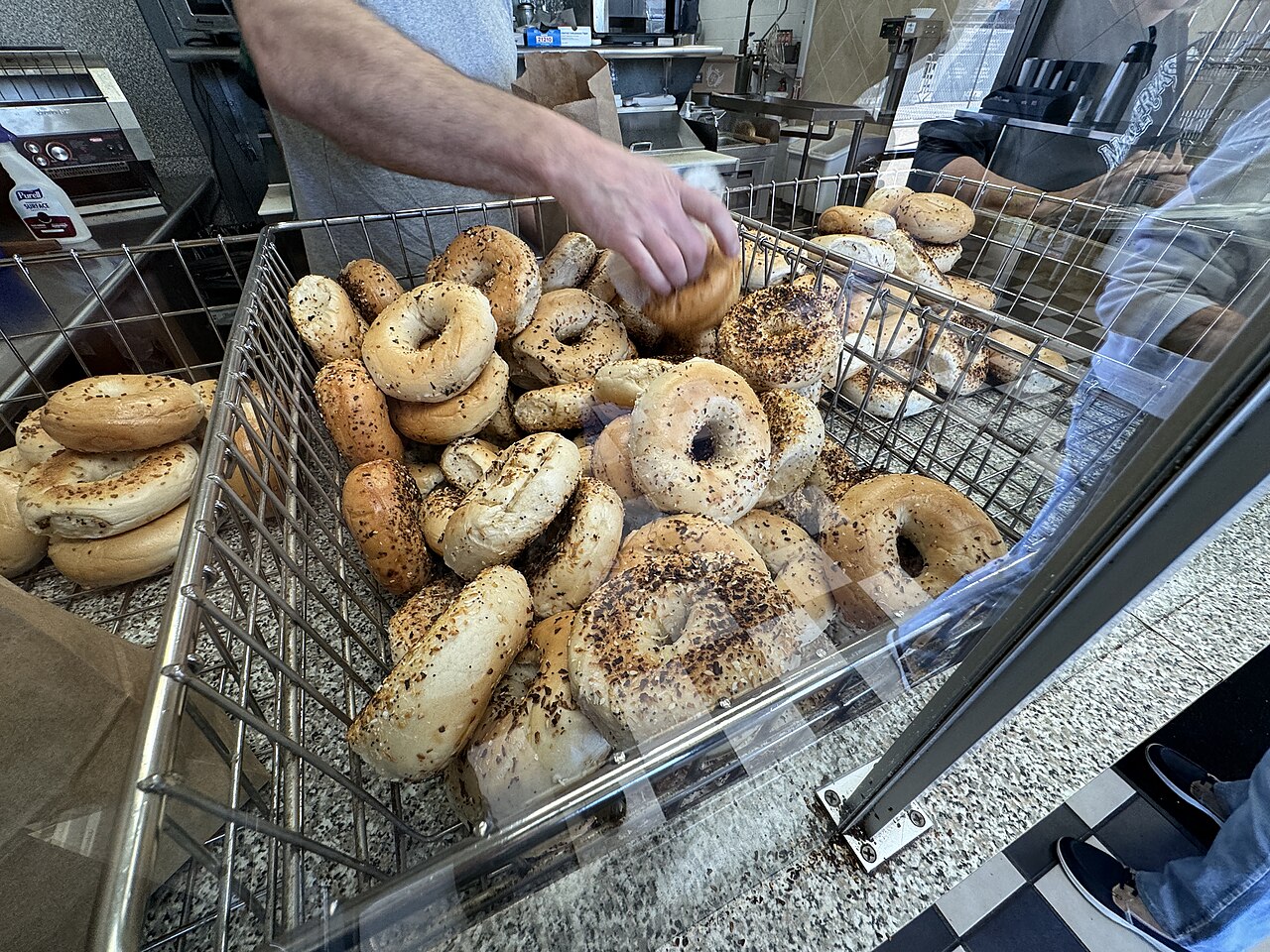
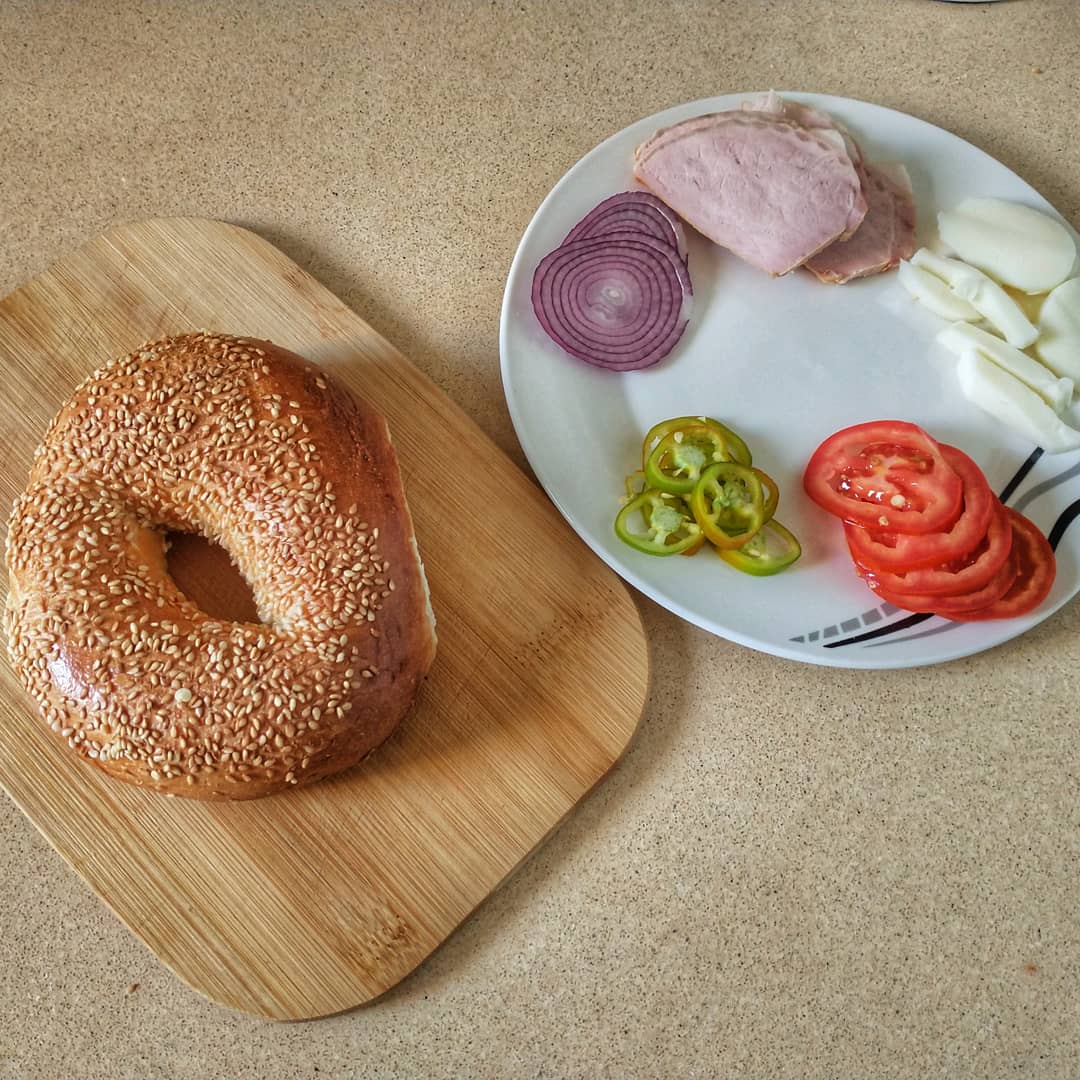
Since the 17th century, the bagel has been inseparable from Ashkenazi Jewish identity, and today it thrives in North America and Poland, particularly in cities with sizable Jewish communities. Supermarkets stock them fresh or frozen in a wide variety of flavors, and traditional toppings—poppy seeds, sesame seeds, coarse salt—remain the most recognizable. Around 1900, New Yorkers elevated the bagel into a full meal: the "bagel brunch," a ring crowned with lox, cream cheese, capers, tomato, and red onion, a combination that endures into the 21st century. The bread itself has undergone a quiet but dramatic transformation in size. Early American bagels weighed roughly two ounces; by 1915 the average had crept to three ounces. Growth accelerated through the 1960s, and by 2003 a typical Manhattan coffee-cart bagel tipped the scale at about six ounces—triple the original. Quality standards, as outlined in a 2012 Consumer Reports evaluation, call for a slightly crisp crust, a satisfying "pull" when a piece is torn away, a chewy interior, and the unmistakable aroma of freshly baked bread, sometimes enhanced by baked-on onion, garlic, or seeds.
Gallery



Frequently Asked Questions
Who is Bagel?
Bagel is a ring-shaped bread roll born in the Jewish communities of Poland, made from yeasted wheat dough. It has been a fixture of Ashkenazi Jewish food culture since the 17th century and is now a widely enjoyed bread product in both Poland and North America.
When does Bagel first appear in the historical record?
The earliest documented reference to Bagel traces back to 1610 in Kraków, Poland, marking it as one of the oldest recorded bread products from the region.
What is Bagel's signature technique?
Bagel is defined by a distinctive two-step cooking process: the shaped ring is briefly boiled before being baked, which produces its dense, chewy crumb and glossy browned crust.
Which community is Bagel most closely tied to?
Bagel is deeply associated with Ashkenazi Jewish communities in Poland, where it became a traditional bread product from the 1600s onward and remains a cultural touchstone.
Why is Bagel considered important in Polish culinary canon?
Bagel sits at the crossroads of Jewish and Polish food heritage, and its boiled-then-baked method set it apart from other European breads. It also carried its reputation far beyond Poland's borders to become a globally recognized bread product.
More in Polish cuisine 1-24
Spotted an error? Know more?
This is a living reference — every entry is fact-audited, and reader corrections feed straight into our audit queue. Suggest an edit · See this site's audit record