Frequently Asked Questions
The most-asked questions about polish cuisine.
What defines Polish cuisine as a distinct culinary tradition?
Polish cuisine is a Central European food tradition built on hearty, comfort-oriented meals featuring potatoes, rye bread, fermented dairy, and slow-cooked meats. It draws from Slavic, German, French, and Turkish influences accumulated over centuries, with a strong emphasis on seasonal ingredients and home-style preparation.
Who are the most influential figures in Polish food history?
While no single chef dominates the narrative, the 19th-century cookbook author Apoloniusz Kędzierski and modern restaurateur Tomasz Wrzos are frequently cited as key voices. More broadly, the tradition is credited to generations of home cooks and the institutional kitchens of Polish monasteries and royal courts.
What are the essential dishes a newcomer should know?
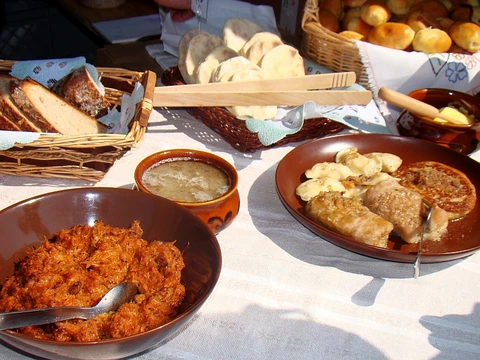
Pierogi (dumplings), bigos (hunter's stew), żurek (sour rye soup), schabowy (breaded pork cutlet), and gołąbki (stuffed cabbage rolls) form the core of what most people recognize as Polish food. These five dishes appear on virtually every introductory list of the cuisine.
What ingredients are central to Polish cooking?
Potatoes, rye flour, sour cream (śmietana), caraway seeds, and smoked paprika appear with remarkable frequency across the cuisine. Fermented products like kefir, pickled cucumbers, and various aged cheeses also play a structural role in everyday meals.
How does Polish cuisine vary by region?
The north leans on Baltic seafood and lighter preparations, while the south favors mountain cheeses, game meats, and richer stews. Silesia in the southwest carries a distinct German-Austrian influence, and Kraków's cuisine retains a more refined, historically courtly character.
What is the historical origin of Polish cuisine?
The tradition developed from medieval Slavic grain-and-dairy staples, was enriched by French techniques during the 17th–18th century royal era, and was further shaped by partition-era German and Austrian contact. The interwar period and post-1945 state socialism both left lasting marks on what ended up on family tables.
Why is fermentation so prominent in Polish food?
Centuries of cold winters and limited refrigeration made preserving food a practical necessity, giving rise to traditions like sauerkraut, pickled cucumbers, and fermented rye soups. These techniques also added the tangy, complex flavors that distinguish Polish taste profiles from neighboring cuisines.
What is a common misconception about Polish food?
Many outsiders reduce it to pierogi and sausage, overlooking the depth of its soup culture, pastry traditions, and regional specialties. In reality, a Polish holiday table can feature dozens of distinct dishes prepared over several days.
How has the modern Polish food scene evolved?
Since the fall of communism, a wave of young chefs has reinterpreted classic dishes with contemporary techniques while sourcing local, often organic, ingredients. Cities like Warsaw and Kraków now host internationally recognized restaurants that put a modern spin on heritage recipes.
Where should a beginner start learning to cook Polish food?
Starting with pierogi, żurek, and a simple bigos gives a solid foundation in dough-making, souring, and slow-cooking techniques that underpin much of the cuisine. From there, exploring regional specialties and holiday dishes like barszcz (beetroot borscht) with uszka dumplings deepens the understanding.